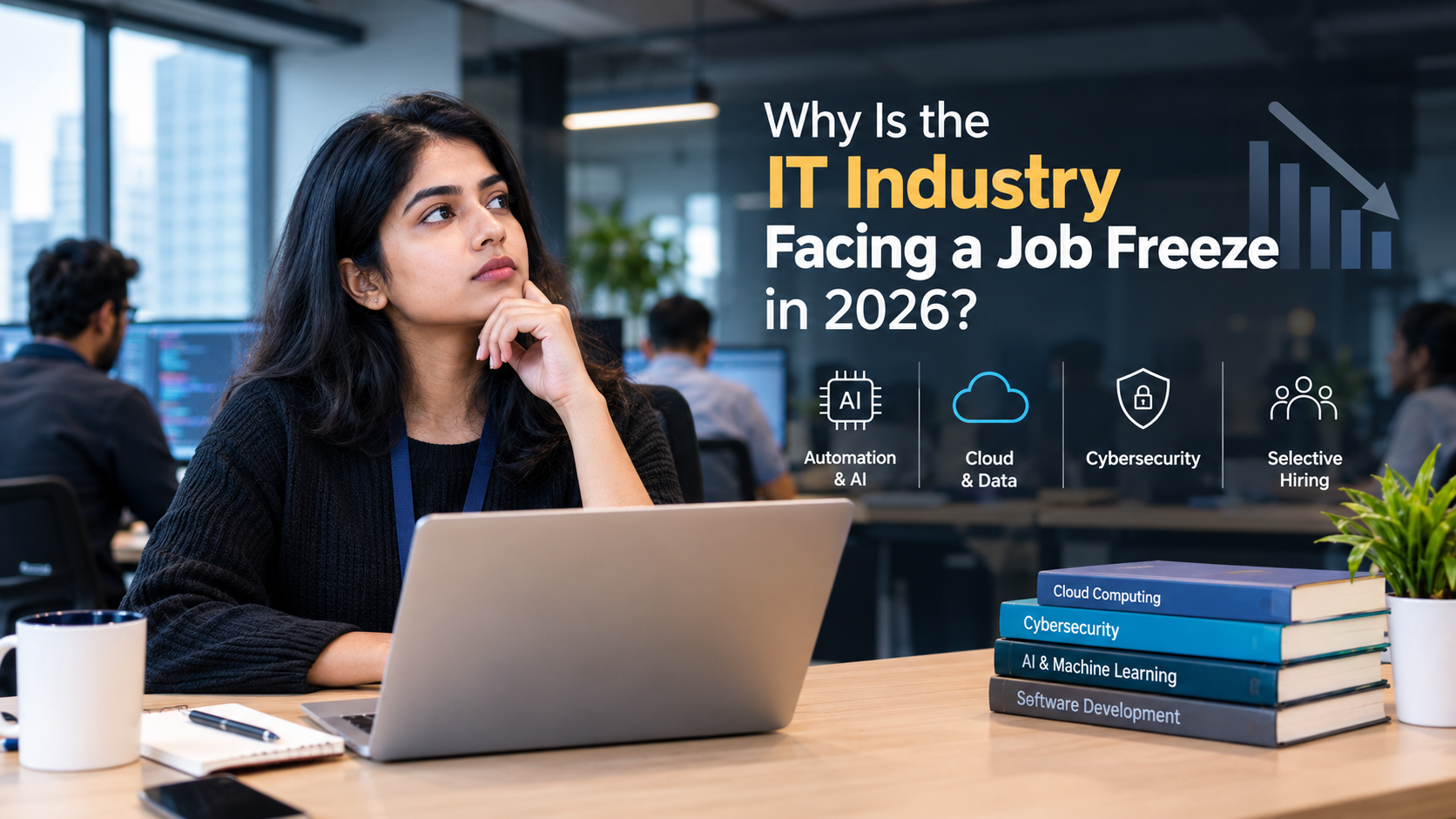
The technology industry has always been associated with growth, but Why Is the IT Industry Facing a Job Freeze in 2026? innovation and new career opportunities. For years, companies expanded their technology teams, recruited fresh graduates and competed aggressively for software professionals.
But 2026 feels different.
Across the IT industry, many professionals are experiencing longer hiring cycles, fewer entry-level openings, selective recruitment and increased competition for available positions. In India, software development and several other technology job categories have also experienced weaker hiring activity compared with previous periods.
This has led to a common question:
Is the IT industry facing a job freeze in 2026?
The short answer is: not exactly.
What we are seeing is less of a complete hiring freeze and more of a change in how technology companies hire, what skills they value and how many people they need for traditional roles.
The IT Hiring Market Is Changing
The traditional IT hiring model was largely based on scale.
When a company won new projects, it often needed more developers, testers, support professionals, analysts and other technology employees. This created large recruitment drives, particularly for entry-level candidates.
That model is becoming less predictable.
Companies are now asking a different question:
“Can we achieve more with the same team by using better technology, automation and AI?”
Artificial intelligence, cloud platforms, automation and modern development tools are changing the economics of technology operations.
This does not mean technology jobs are disappearing.
Instead, companies are becoming more selective about which positions they add and which skills they need.
1. Artificial Intelligence Is Changing Traditional IT Work
AI is one of the biggest reasons behind the changing IT employment landscape.
Modern AI tools can assist developers with coding, testing, documentation, data analysis and other repetitive activities. As these tools become more capable, companies can potentially complete certain tasks with smaller teams or redirect employees toward higher-value work.
India’s technology sector is already seeing stronger demand for professionals with AI-related capabilities, while traditional hiring remains comparatively cautious.
This creates an important distinction.
Companies may not be saying:
“We don’t need technology professionals.”
They may instead be saying:
“We need fewer people doing routine work and more people who can work effectively with modern technology.”
2. Entry-Level Hiring Is Under Greater Pressure
Fresh graduates have traditionally been an important source of talent for India’s IT industry.
Large technology companies could recruit graduates in significant numbers, train them and gradually develop their technical capabilities.
In 2026, that approach is becoming more selective.
Companies increasingly want candidates who can contribute sooner, particularly in areas where projects require practical technical knowledge.
Current industry reporting indicates that campus recruitment remains weak while organisations continue to look for specialised talent.
For freshers, this means a degree alone may no longer be enough.
Candidates who combine their education with practical development experience, cloud knowledge, databases, programming skills, cybersecurity awareness or AI-related capabilities can have a stronger position in the market.
3. Companies Are Hiring for Skills, Not Just Job Titles
Another major change is the move toward skills-based hiring.
A few years ago, a company might simply advertise for a “Software Developer.”
Today, the requirement can be much more specific.
An employer may need:
- Backend .NET developers
- Java developers
- Python developers
- Full-stack engineers
- Cloud engineers
- DevOps professionals
- Database specialists
- Cybersecurity professionals
- Data engineers
- QA engineers
- AI and machine-learning specialists
This reflects a broader change in the technology workforce.
Employers are increasingly looking for professionals who can solve a particular business or technology problem rather than simply fill a general IT position.
4. AI Is Creating New Jobs While Reducing Some Traditional Demand
It would be inaccurate to say that AI is only destroying jobs.
It is also creating new categories of work.
India’s AI hiring market is expanding into areas such as AI engineering, agentic AI, AI architecture, AI platforms and enterprise AI implementation.
The same technology that automates certain activities can therefore create demand for professionals who know how to build, integrate, manage, test and secure AI-enabled systems.
This is why the 2026 IT employment market can look confusing.
One professional may struggle to find a traditional software position while another with specialised AI, cloud or cybersecurity expertise receives multiple opportunities.
The market is not moving in one direction. It is becoming more specialised.
5. Automation Is Reducing the Need for Some Routine Activities
Automation is not new to IT.
What has changed is the speed and capability of modern automation.
Tasks that previously required significant human involvement can now be assisted by software, automation platforms and AI-based tools.
Examples include:
- Repetitive testing activities
- Basic code generation
- Routine documentation
- Standard data processing
- Simple technical support
- Repetitive reporting
- Certain infrastructure operations
However, automation still requires people to design systems, manage processes, validate results, solve complex problems and take responsibility for business outcomes.
This means the value of human expertise is changing rather than simply disappearing.
6. The Demand for Experienced and Specialised Talent Has Not Disappeared
One of the most important points for job seekers to understand is that a hiring slowdown does not mean every IT role is disappearing.
Current market reporting shows continued demand for specialised technology capabilities, including AI, cloud, data and cybersecurity.
Companies still need professionals who can:
- Build reliable software
- Manage cloud infrastructure
- Protect systems and data
- Develop enterprise applications
- Manage databases
- Build data platforms
- Integrate AI into business systems
- Maintain quality and security
- Lead complex technology projects
The challenge is that these opportunities may require a more specific combination of skills than employers demanded previously.
7. Why Does It Feel Like a Job Freeze?
The feeling of a job freeze comes from several factors happening at the same time.
Recruitment can feel particularly difficult when:
Fewer entry-level positions + selective replacement hiring + AI-driven productivity + higher skill requirements + strong candidate competition = a tougher IT job market.
Companies may still be hiring, but the number of openings may be smaller and the hiring process more selective.
For candidates, this creates the impression that “there are no jobs.”
In reality, there are jobs — but the distribution of opportunities is changing.
What Should Employers Do in 2026?
The hiring slowdown also creates an opportunity for employers.
Instead of waiting for the perfect candidate to appear, companies should clearly define the skills required for each position.
A strong recruitment strategy should focus on:
- Clearly defined technical requirements
- Practical assessment of candidate capabilities
- Relevant experience rather than keyword matching
- Potential for learning and adaptability
- Cultural and business fit
- The ability to work with modern technology
Companies should also avoid assuming that every technology role can be replaced by AI.
AI can improve productivity, but successful technology projects still require human judgment, architecture, leadership, communication and accountability.
The Future of IT Hiring Is Selective, Not Empty
Calling 2026 a complete IT job freeze would oversimplify what is actually happening.
The technology industry is going through a period of adjustment.
Some traditional roles are facing pressure. Entry-level recruitment is more competitive. Companies are controlling workforce costs. Automation is changing repetitive work.
At the same time, new opportunities are emerging around AI, cloud, cybersecurity, data, software engineering and specialised technology services.
The real change is therefore not simply about fewer jobs.
It is about different jobs, different skills and different expectations.
Final Thoughts
The IT industry has never remained static.
Programming languages change. Development methodologies change. Cloud computing changed infrastructure. Mobile technology changed software development. And now AI is changing how technology work itself is performed.
The professionals and organisations that adapt to these changes will be better positioned for the next phase of the industry.
For job seekers, the message is simple:
Do not stop learning because the market is difficult. Learn because the market is changing.
For employers, the lesson is equally important:
Do not hire simply to increase headcount. Hire the people who can help your business move forward.
At Suvrion, we believe effective technology hiring is about connecting organisations with professionals whose skills match their real business requirements. As the IT employment landscape evolves, a thoughtful and skills-focused approach to recruitment will become increasingly important.
The IT job market may be more selective in 2026, but it is certainly not standing still.