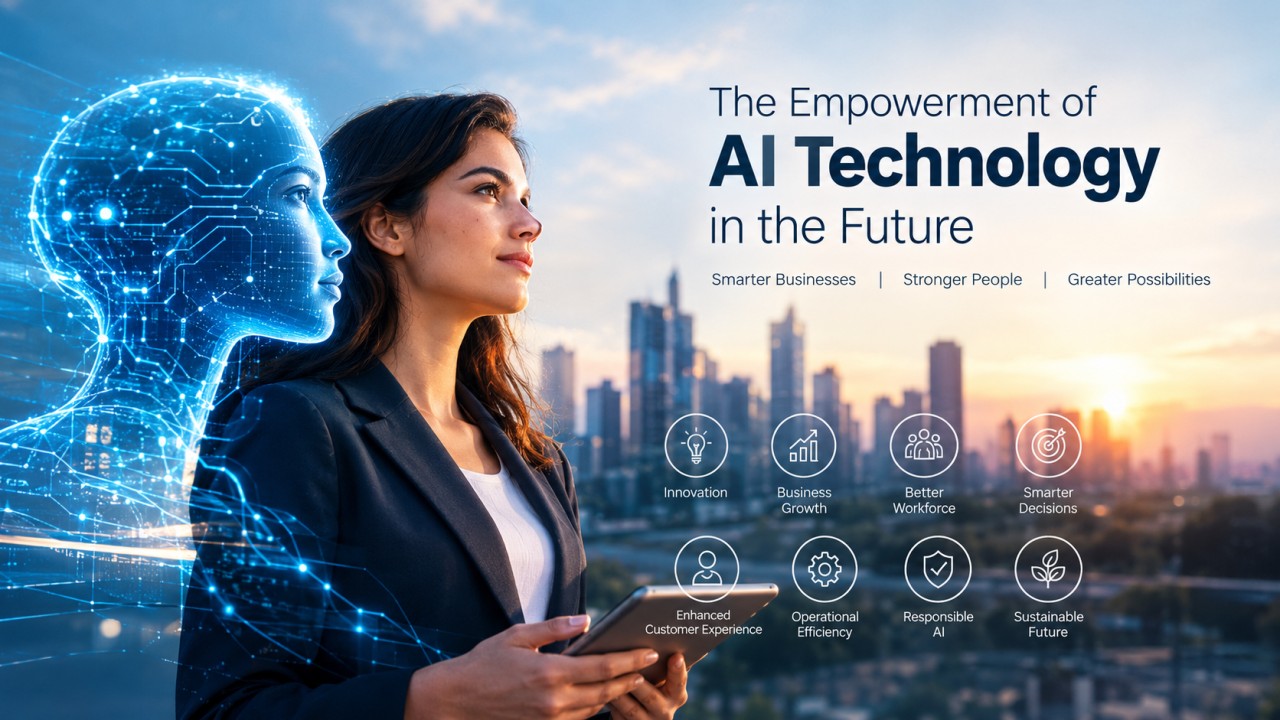
AI technology in the future is no longer a distant vision of the future. It is becoming one of the most powerful forces shaping how businesses operate, how people work, and how decisions are made.
From automating routine processes to helping organizations understand complex information, artificial intelligence is changing the way value is created. But the real opportunity of AI lies beyond automation. Its greatest potential is in empowering people to think better, work smarter, innovate faster, and make more informed decisions.
As AI continues to evolve, organizations that understand how to use it responsibly and strategically will be better positioned to adapt to a rapidly changing business environment.
What Does AI Empowerment Really Mean?
AI empowerment means using artificial intelligence to extend human capabilities rather than simply replace human effort.
Traditional automation focuses primarily on performing predefined tasks. Modern AI technology in the future can go much faster then current age. It can analyze information, identify patterns, generate ideas, assist with decision-making, personalize experiences, and help teams solve problems that would previously require significant time and resources.
The future of AI is therefore not simply about machines doing more work.It is about people being able to accomplish more with intelligent technology by their side.
For businesses, this shift can create opportunities to improve productivity, strengthen customer experiences, reduce operational complexity, and develop new ways of delivering products and services.
AI and the Future of Business
Businesses are already operating in an environment where speed, adaptability, and access to information can significantly influence success.
AI can support organizations across multiple areas, including:
Business and data analysis
Customer service and engagement
Marketing and content development
Financial and operational planning
Process automation
Risk identification
Supply chain management
Research and innovation
Human resource management
Strategic decision-making
The value comes from integrating AI into business processes thoughtfully rather than adopting technology simply because it is available.
Organizations that approach AI strategically can create systems where technology handles repetitive and data-intensive work while people concentrate on strategy, creativity, relationships, leadership, and complex judgment.
The Human Advantage Will Become More Important
As artificial intelligence becomes more capable, human qualities will not become irrelevant. In many ways, they will become even more valuable.
AI can process enormous amounts of information, but organizations still need people who understand context, responsibility, ethics, culture, and human needs.
Skills such as:
Critical thinking.
People must be able to question AI-generated information, evaluate alternatives, and recognize limitations.
Creativity.
AI can generate possibilities, but human imagination, experience, and perspective remain essential for meaningful innovation.
Communication.
Technology can provide information, but people still need to build trust, explain decisions, and create meaningful relationships.
Leadership.
Successful AI adoption requires leaders who can connect technology with organizational goals and help teams adapt to change.
Ethical judgment.
AI decisions can have real consequences. Human oversight is essential when technology affects customers, employees, finances, privacy, or society.
The future is therefore unlikely to be about humans versus AI.
It will increasingly be about humans working effectively with AI
AI Can Make Better Decisions Possible
Modern businesses generate enormous amounts of information every day. The challenge is not simply collecting data—it is turning that data into useful insight.
AI can help organizations identify patterns, compare information, detect anomalies, and generate insights at a scale that would be difficult to achieve manually.
For business leaders, this can create a stronger foundation for decision-making.
However, AI should support decisions rather than blindly determine them.
A successful organization will combine AI-driven insights with human experience, business understanding, and sound judgment.
That combination can lead to decisions that are not only faster, but also more thoughtful and informed.
AI and Customer Experience
Customer expectations are changing rapidly. People increasingly expect businesses to provide fast, relevant, convenient, and personalized experiences.
AI can help organizations understand customer behavior and respond more effectively.
Intelligent systems can support personalized recommendations, automated assistance, faster responses, customer insights, and more efficient service processes.
But technology alone does not create a great customer experience.
Customers still value understanding, empathy, transparency, and trust.
The strongest organizations will use AI to make customer interactions more efficient while ensuring that the human element remains at the center of important relationships.
AI Will Accelerate Innovation
Innovation often requires experimentation, research, analysis, and the ability to explore multiple possibilities.
AI can significantly reduce the time required for many of these activities.
Businesses can use AI to explore ideas, analyze markets, summarize research, identify emerging trends, test concepts, and support product development.
This can lower the barriers to experimentation.
A small team with the right AI tools may be able to perform tasks that once required much larger resources. This creates opportunities for businesses of different sizes to compete through ideas, agility, and intelligent execution.
The future may belong not only to organizations with the largest resources, but also to those that can learn, adapt, and innovate effectively.
Preparing Businesses for an AI-Powered Future
AI adoption should not begin with the question, “Where can we use AI?”
A better question is:
“What business challenges can AI help us solve?”
Organizations can begin by identifying processes that are repetitive, time-consuming, data-intensive, or difficult to scale. From there, they can evaluate where AI can create measurable value.
A practical AI transformation approach can include:
1. Identify Business Priorities
Start with business objectives rather than technology. Determine what the organization wants to improve—productivity, customer experience, operational efficiency, decision-making, innovation, or growth.
2. Evaluate Existing Processes
Understand how work is currently performed. This helps identify where AI can complement existing systems and where process improvements may be required first.
3. Select the Right AI Applications
Not every problem requires sophisticated AI. The right solution should be selected based on business value, feasibility, cost, security, and long-term scalability.
4. Prepare People
Technology adoption is ultimately a people-driven process. Employees need appropriate training, guidance, and confidence to work effectively with AI.
5. Measure Results
AI initiatives should have measurable outcomes. Organizations should continuously evaluate productivity, quality, customer satisfaction, cost, risk, and other relevant business indicators.
6. Scale With Purpose
Successful AI initiatives can gradually expand across the organization—but scaling should remain aligned with business strategy and responsible technology practices.
The Future of AI Is About Possibility
The next phase of artificial intelligence will likely bring increasingly capable systems, greater automation, more personalized digital experiences, and deeper integration into everyday business operations.
But technology itself is not the destination.
The real opportunity is what organizations and people can achieve with it.
AI can help businesses move faster. It can help professionals work more efficiently. It can help leaders understand complex information. It can help organizations discover opportunities that might otherwise remain hidden.
Yet meaningful progress will depend on how intelligently AI is introduced and managed.
The organizations that succeed will be those that combine technology with human intelligence, innovation with responsibility, and automation with purpose.
Building a Future Where AI Empowers People
Artificial intelligence represents one of the most significant technological shifts of our time. Its impact will extend far beyond individual tools or automated tasks.
It has the potential to reshape how organizations operate, how professionals develop their capabilities, and how businesses create value.
The future should not be defined by the question of whether AI will replace people.
A more meaningful question is:
How can we use AI to empower people to achieve what was previously difficult, slow, or impossible?
That is where the true potential of AI lies.
At Suvrion Consulting, we believe technology creates the greatest value when it is connected to clear business objectives, practical solutions, and sustainable growth. The future of AI will belong to organizations that are prepared to embrace change while keeping human insight, responsibility, and purpose at the heart of transformation.